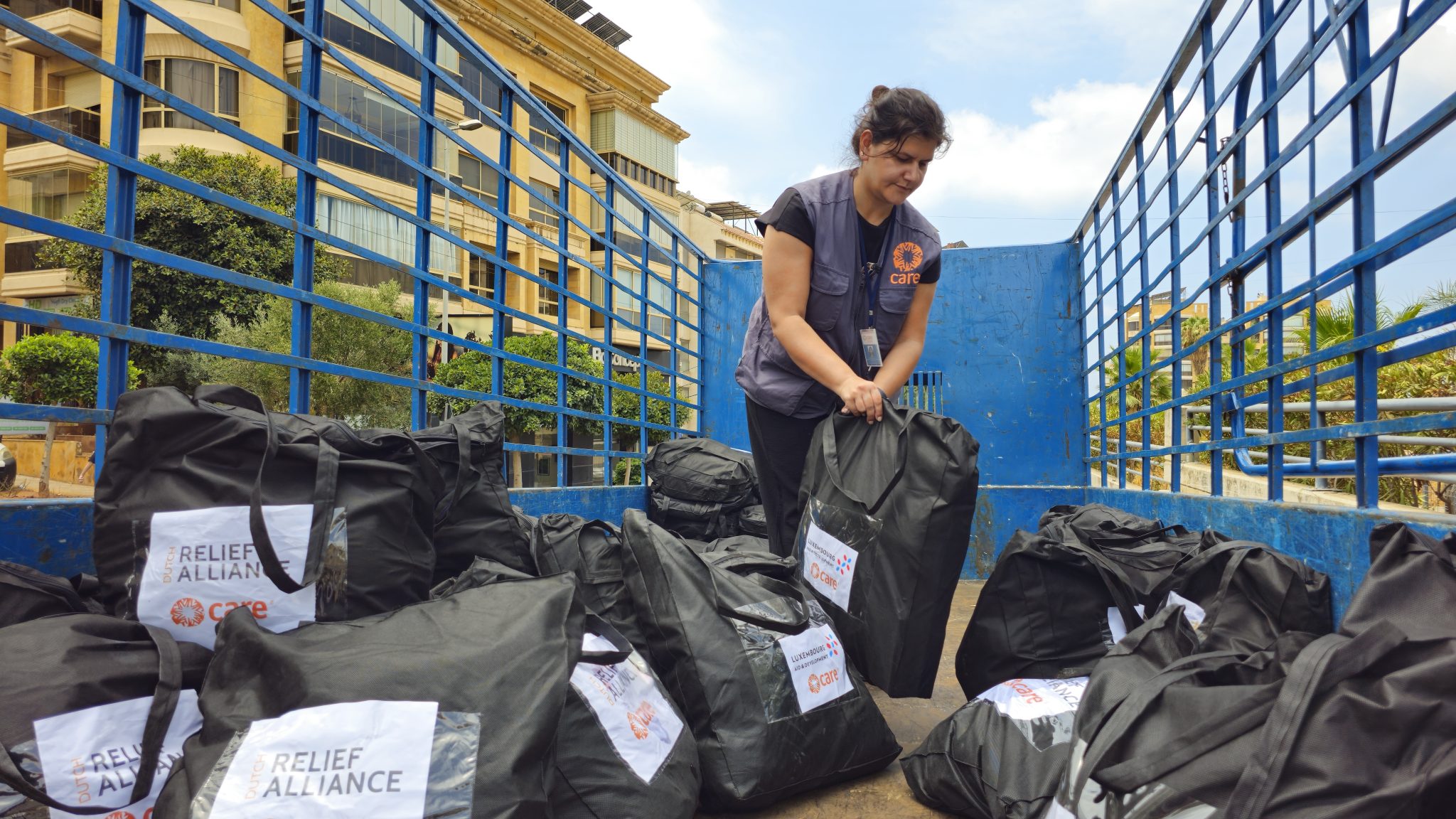
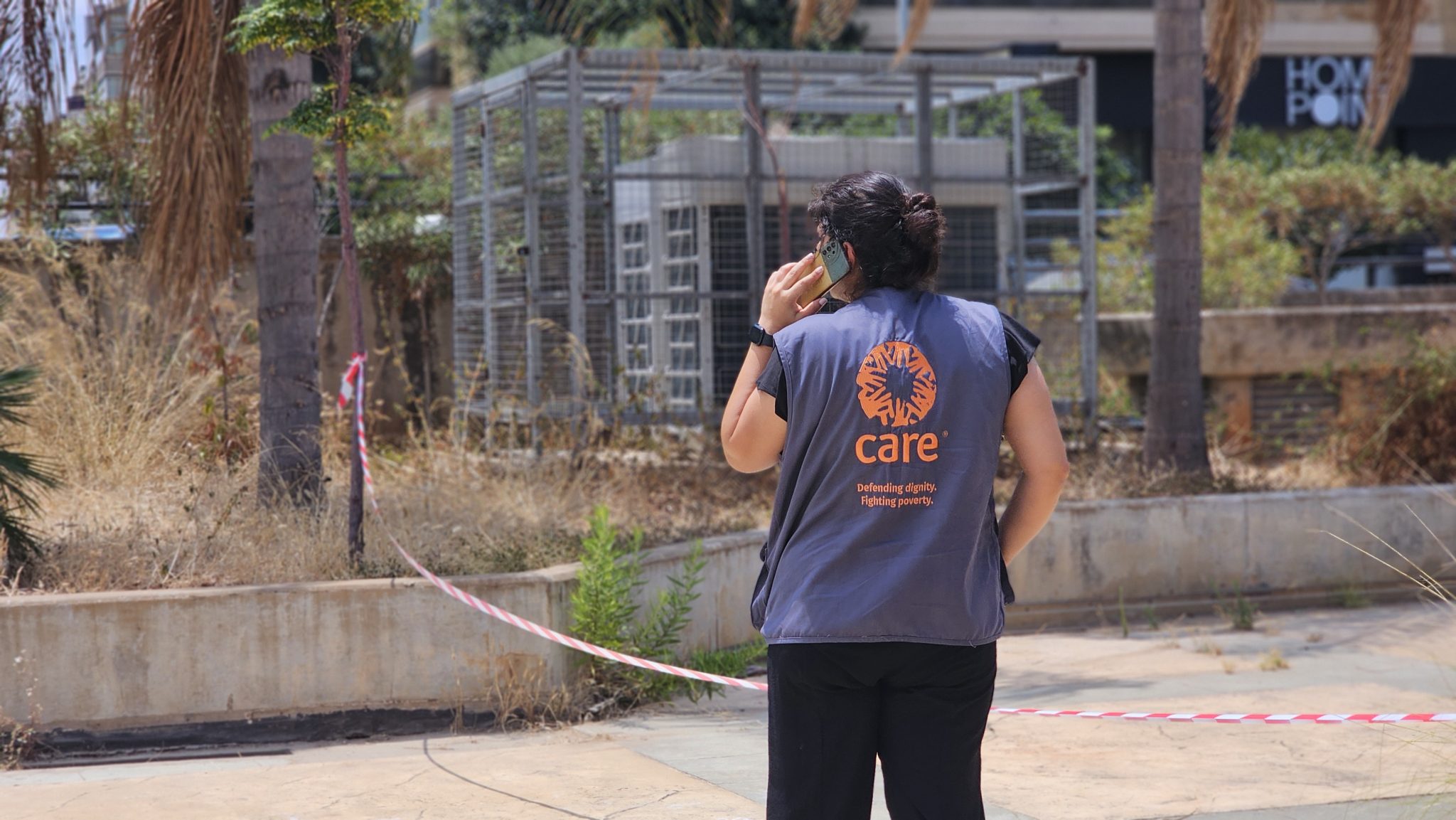
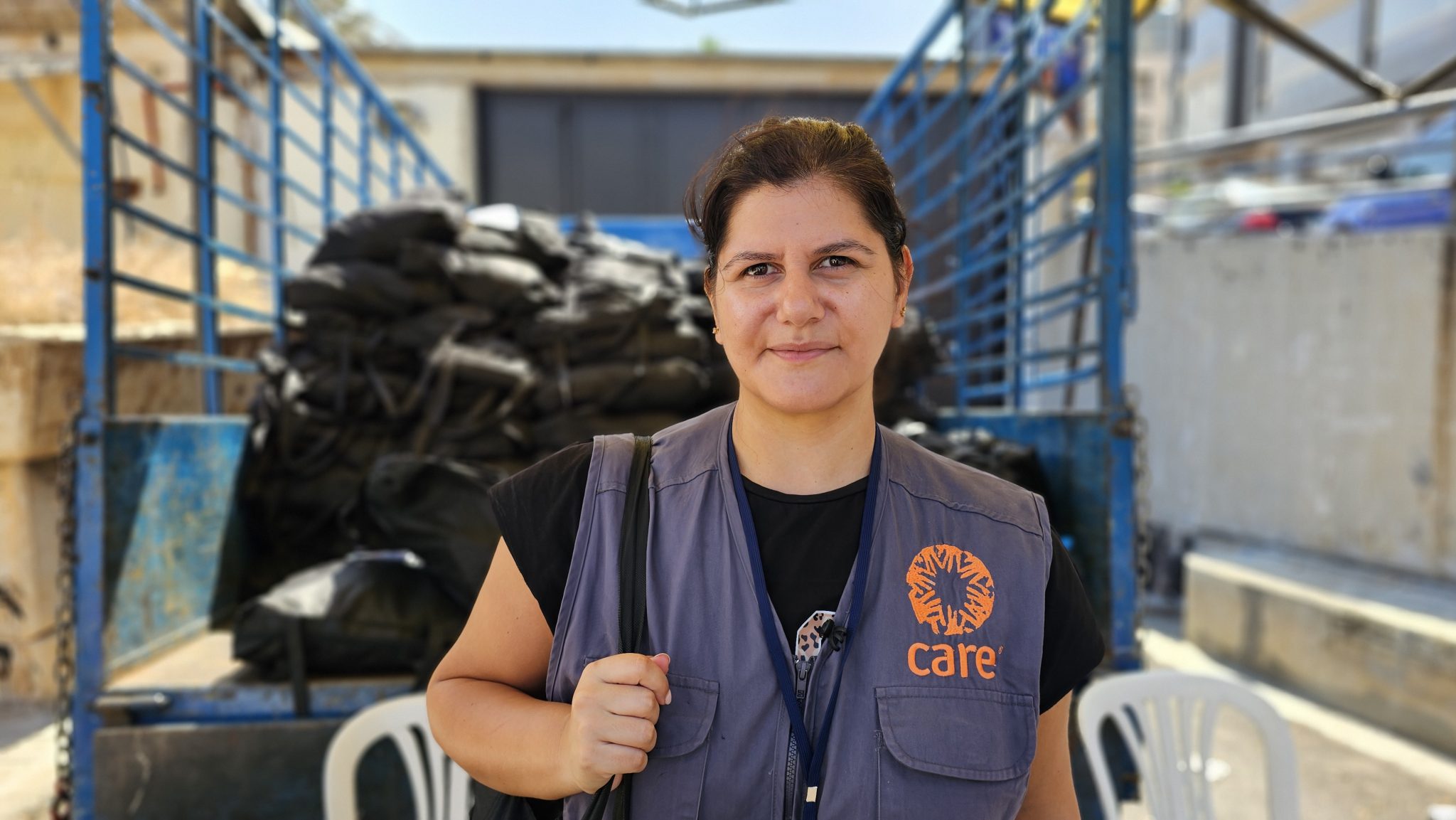
The phone stays in Eliane’s hand even as she lifts another black carrier bag from the back of a truck. Every few minutes it lights up. She answers a colleague’s question. A project participant needs help. The delivery truck needs to be moved. Somewhere overhead, the familiar deep buzzing of a drone cuts through the humid Beirut air.
Eliane does not look up. There is work to do.
As CARE International in Lebanon’s Gender and Protection Manager, she is leading a dignity kit distribution in urban Beirut today. The selected square is surrounded by high-rise buildings, some of which still bear the scars of air strikes earlier this year.
Six white pop-up gazebos stand in a circle, ending at a truck stacked with black bags containing the CARE dignity kits, packed with menstrual pads, shampoo, toothpaste, towels, torches, whistles, hot water bottles, and other essentials.
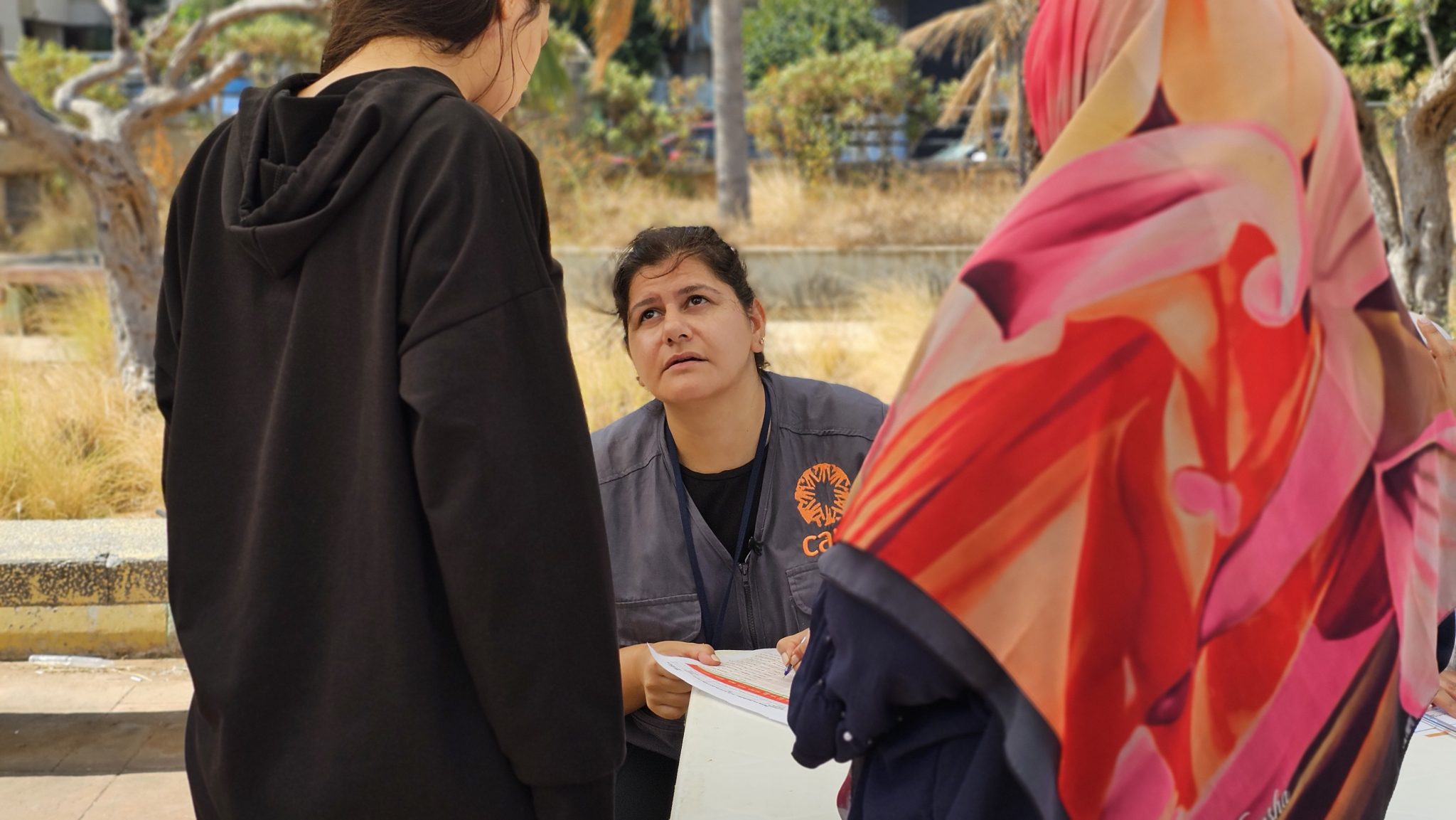
Women move from one station to the next. Starting with the registration. Information. An awareness session on gender-based violence. Flyers with contacts for support services, before they scoop the bags over their shoulders and carry them to wherever home currently is for them. Either a far-too-expensive rental apartment. Or an overcrowded family home. The backseat of their cars parked on the side of the road. Or an informal settlement with pitched tents.
For Eliane, these dignity kit distributions are an integral part of any emergency response.
“This conflict has displaced many women who did not even pack a bag. In emergencies the priority often lies with food, water and shelter, but such essential items are often forgotten. This can lead to serious health consequences for women and girls.”
Today, 500 displaced people will receive dignity kits. They arrive in small groups throughout the day, many displaced from southern Lebanon or the southern suburbs of Beirut where air strikes made it unsafe to stay or return to.
By midday, the heat hangs heavy over the square. Eliane seems to be everywhere at once solving problems, answering questions, handing out dignity kits, or filling out forms.
“A distribution like this includes heavy coordination with all parties involved, such as the disaster risk reduction unit, the municipality and other organisations, in order to avoid duplication and to balance the areas we are working in, so we can reach as many people as possible.”
But logistics are only one part of the job.
As humanitarians, we work in a field in which we are affected ourselves. We have staff who have been displaced or are worried about family members.
Lebanon’s conflict has displaced hundreds of thousands of people in repeated waves, forcing families to flee with little warning as neighbourhoods come under attack. Humanitarian workers respond while living through the same insecurity as the people they serve.
“The constant buzzing of drones, day and night, accompanies every part of my life. It punctuates everything I do, at work and outside of work. It’s a constant source of stress and a relentless reminder that the war is still here. I go to work, run errands, and carry on with daily life, yet the sound never leaves. Somehow, though I’m not sure how to describe it, I’ve learned to live alongside it,” Eliane says and pauses before she continues,
“The sonic booms of fighter jets are even more triggering than the drones, especially having lived through the Beirut port explosion. Every blast brings back memories I wish I could leave behind. And yet, despite it all, my colleagues and I continue our work because we know that every displaced person we meet carries a story of their own and is in urgent need of support.”
But not just at work she is dealing with the conflict. “When the workday ends and I go home, hoping to rest and process everything I have witnessed, I can’t. My mind fills with endless questions, worries, and memories. Even in the quiet moments, the war never truly leaves you.”
Even silence feels dangerous.
I worry about putting in my noise-cancelling headphones to block out the sound of war, because I need to know if something happens close to me.
One day remains fixed in her memory. “For me, the scariest day was April 8th this year, when more than 100 bombs dropped over Beirut within 10 minutes.” She remembers standing in the CARE office as the explosions echoed across the city.
“We immediately started checking on our families, friends, and colleagues to make sure they were safe. At the same time, we were trying to understand what was happening, where the strikes had landed, and what it would mean for the people we support,” says Eliane.
“In humanitarian work, every escalation changes the situation. We were already thinking about where needs would emerge, whether planned distributions would still be possible, and how we would need to adapt our response. Outside, traffic had come to a complete standstill. It wasn’t safe to leave, so we stayed in the office, following the developments minute by minute and hoping that everyone we cared about would be safe.”
Since then, the feeling has never completely left.
“I am always aware that the next bomb could fall anywhere. Even during a distribution, the situation can change in an instant. We constantly assess the risks, and we are always prepared to stop our work and move the team to safety if needed. Keeping both our colleagues and the communities, we serve safe is a responsibility that never leaves my mind.”
Every day, women tell her they feel the pressure of trying to stay strong for their children. Older people speak about fleeing not just in this conflict, but in previous wars stretching back decades. She has learned to carry those conversations carefully.
Listening to these stories of trauma is never something you truly get used to. But who are we without our empathy? If we become numb, we lose an essential part of our humanity.
For Eliane, this crisis has never been distant.
These are my people. What they went through is personal to me. They have witnessed so much pain, live in their cars and have lost so much: their loved ones, their homes, everything they owned and worked for their whole lives.
For Eliane, it is her team that carries her forward. “I have an incredible team. They work so hard, and it really helps that we have good communication with each other. We ask each other what we need or what we can do for one another. We take care of each other,” she says while at the same time a colleague walks over from another station and asks her whether she has eaten yet and whether she would like a soft drink. She laughs.
“The team is fantastic. I don’t know what I would do without them. We went through a lot together and still do every day. But with them, I can face these challenges and hardships.”
Then her phone rings again. Eliane answers it, picks up another dignity kit with her phone wedged between her shoulder and ear, and continues her work. Like every day. Today. Tomorrow. Next week. Because even though she herself is affected, there are others who need her.
This story has been written by Sarah Easter, CARE Emergency Communications Officer, as part of the CARE’s World Humanitarian Day series.
About World Humanitarian Day
World Humanitarian Day (19 August) was originally designated by the United Nations General Assembly in commemoration of the 22 aid workers who lost their lives in a bomb attack in Baghdad in 2003. Every year, this date marks a moment to advocate for the survival, wellbeing and dignity of people affected by crises, and for the safety and security of aid workers.
Lebanon is facing one of the most severe impacts of the growing humanitarian crisis in the Middle East, with more than one million people displaced and shelters stretched nearly to capacity.
To continue supporting humanitarian responses to emergencies like the crisis in Lebanon, donate to CARE’s Global Emergency Fund today.