Uddhav Prasad Nepal, Betrawoti, Nuwakot District, Recipient of CARE PACKAGE® for Emergencies
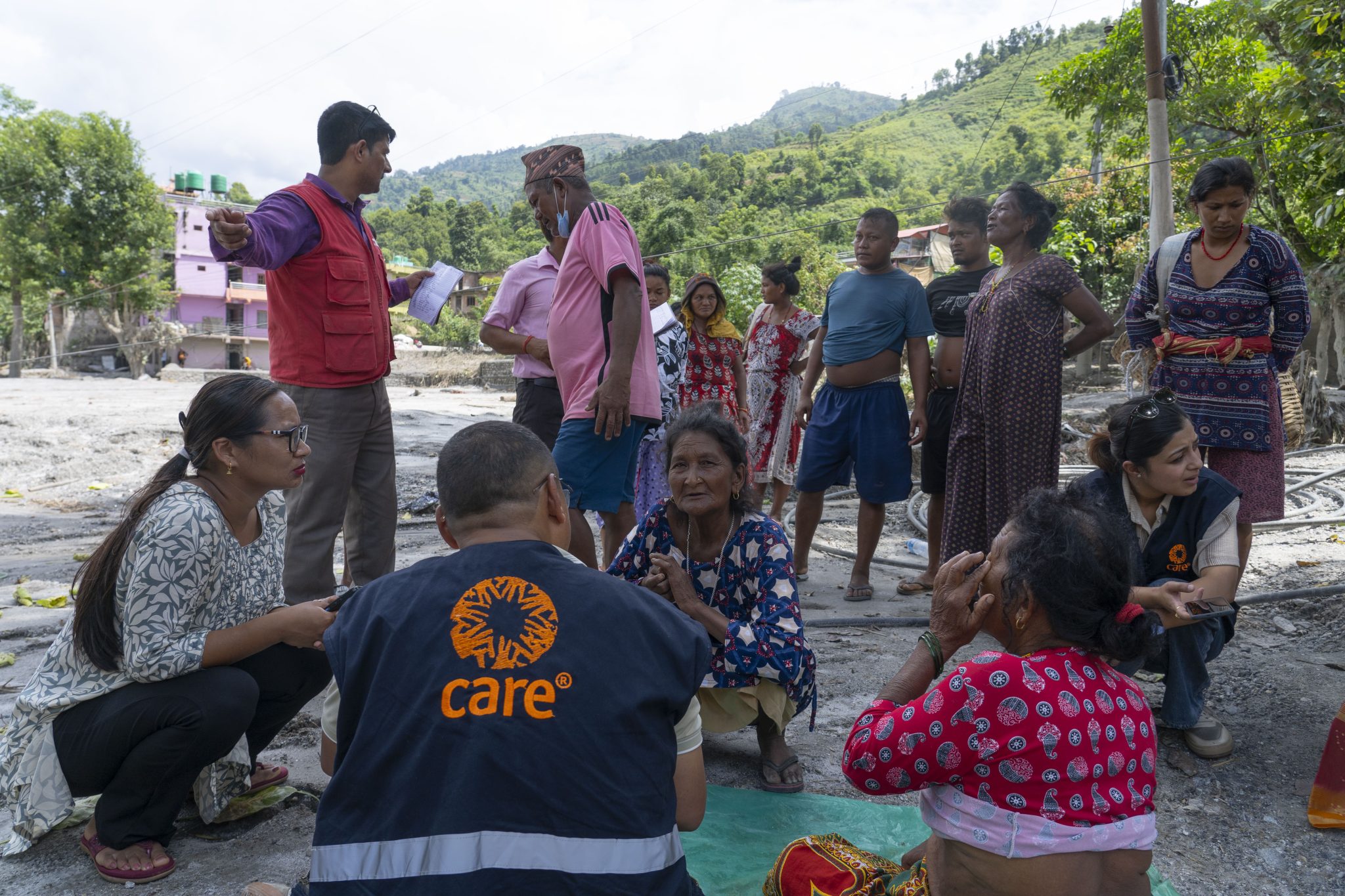
“The flood has completely wiped out our settlement, and none of the houses that remain are safe to live in. We are currently staying on higher ground [under open sky], and our most immediate need is shelter. A few organisations have provided us with food, which has been a great help. The CARE PACKAGE® for Emergencies will provide much-needed support for temporary shelter and help us get through this difficult time. We are also concerned about the risk of disease outbreaks due to the accumulation of flood debris and dead livestock in the affected areas.”
Kisang Nurpu, Chairperson, Gosaikunda Rural Municipality
“Syabru is the worst-affected area. Apart from Syabru, people in Thulo Syabru, Bharku, Sano Bharku and Thulo Bharku are also stuck and unable to move. If road access remains blocked and supplies stop coming, we will have to manage with whatever we have. We are already seeing that the roads and pathways are being blocked, and our food stocks are decreasing every day.
The first thing we need is information. I have already deployed focal persons to different locations to collect data on the situation and the needs of people. At the shelter here, people are also arriving from the fair in Gosainkunda. Around 50 additional people are taking shelter here every day, and the number is increasing.
We urgently need food supplies, including rice, lentils, salt and oil. We also need communication support. I want to set up backup points in key locations where people can charge their phones and access the internet. This is important so they can stay in contact with their families and loved ones, both within the country and abroad. So, I need support on all of these issues. The local government is already doing a lot — from rescue and response to providing whatever resources are available — but the needs are much greater than what we can manage alone.
I also want to work with local NGOs, especially organisations we have worked with before, as well as INGOs. If we work together, the response will be more sustainable. At the same time, I request organisations not to bring unnecessary materials. People are taking risks to bring supplies here, so we need to make sure that what comes is actually needed.
We need accurate information about what is actually required. My priority now is the safety and security of the people who have survived and those who are still here.
At the moment, there is no other possible way to travel except by helicopter. We have to use helicopters to reach people and move supplies.
People have started saying that when we tell them to stay where they are, it feels like we are telling them to stay there and die. The situation is that serious.”
Bimal Ghimire, Health Coordinator, Government Official, Gosainkunda Rural Municipality
“We are collecting data on the people affected, with women and children being prioritised. Those who can be rescued are being taken to holding centres. There is an urgent need for clothes, shoes and slippers, first-aid supplies for injuries and food. The health centres are open wherever they are able to function, even in the difficult conditions. However, we have lost contact with some of these health centres, so we do not know the full extent of their needs. We urgently need solar chargers so that people can keep their phones working and stay in contact with one another and with us.”
ENDS
For media enquiries contact Julia Dotras on 0494 396 407
- More information on CARE’s emergency response in Nepal: Nepal Floods 2026: CARE’s emergency response
- More information on the CARE PACKAGE® for Emergencies: CARE PACKAGE® for Emergencies
- To donate to the Nepal floods Emergency Appeal: Donate Now to the Nepal Flood Emergency Appeal
About CARE Nepal
CARE began working in Nepal in 1978 as one of the country’s first international humanitarian organisations. For over 40 years, CARE Nepal has partnered with at-risk communities to fight poverty, promote equality, teach practical skills, and help people build better lives. Today, CARE Nepal works to address the root causes of poverty and discrimination — whether based on gender, background, or location. The organisation also helps communities prepare for and respond to environmental change and natural disasters. In fiscal year 2025, CARE in Nepal reached 1.14 million people, 53% of whom were women and girls.
About CARE Australia
CARE Australia supports women around the globe to save lives, defeat poverty and achieve social justice. We work in partnership with local communities to provide equal opportunities for women that they have long been denied: the ability to earn an income, gain access to their fair share of resources, to lead and participate in decisions that affect their lives, and to be able to withstand the increasing impacts of climate disasters and other crises. www.care.org.au