CARE Nepal is working with government and local partners to get emergency assistance to the families most affected, after flash flooding struck Nepal’s Rasuwa, Nuwakot, and Dhading districts on 26th August.
“Relief efforts prioritise those most in need, particularly women, girls, older people, and people with disabilities, who are often hit hardest in the aftermath of a disaster like this,” says CARE Nepal Country Director, Mona Sherpa.
Beyond the immediate rescue, communities face challenges around shelter, food, safe water, health services, protection, and ways to earn a living again. Older people, children, and people with disabilities face those risks differently. To address this, CARE is carrying out a rapid assessment of how the flood and displacement are affecting women and girls in different ways.
At the same time, CARE is working with the National Disaster Risk Reduction and Management Authority (NDRRMA), local partner organisations, and Humanitarian Partnership Platform members to reach affected communities with essential support. Some of CARE’s partner organisations include Community Self Reliance Centre, Community Development Centre Nepal, Manekor Society Nepal, and Sahayatri Samaj Nepal.
Reaching people is the most difficult aspect of the response so far. Washed-out roads and destroyed bridges have left the worst-affected communities extremely difficult to reach, especially in Rasuwa.
“The access, be it road and communication, all those things are very difficult,” says Sherpa.
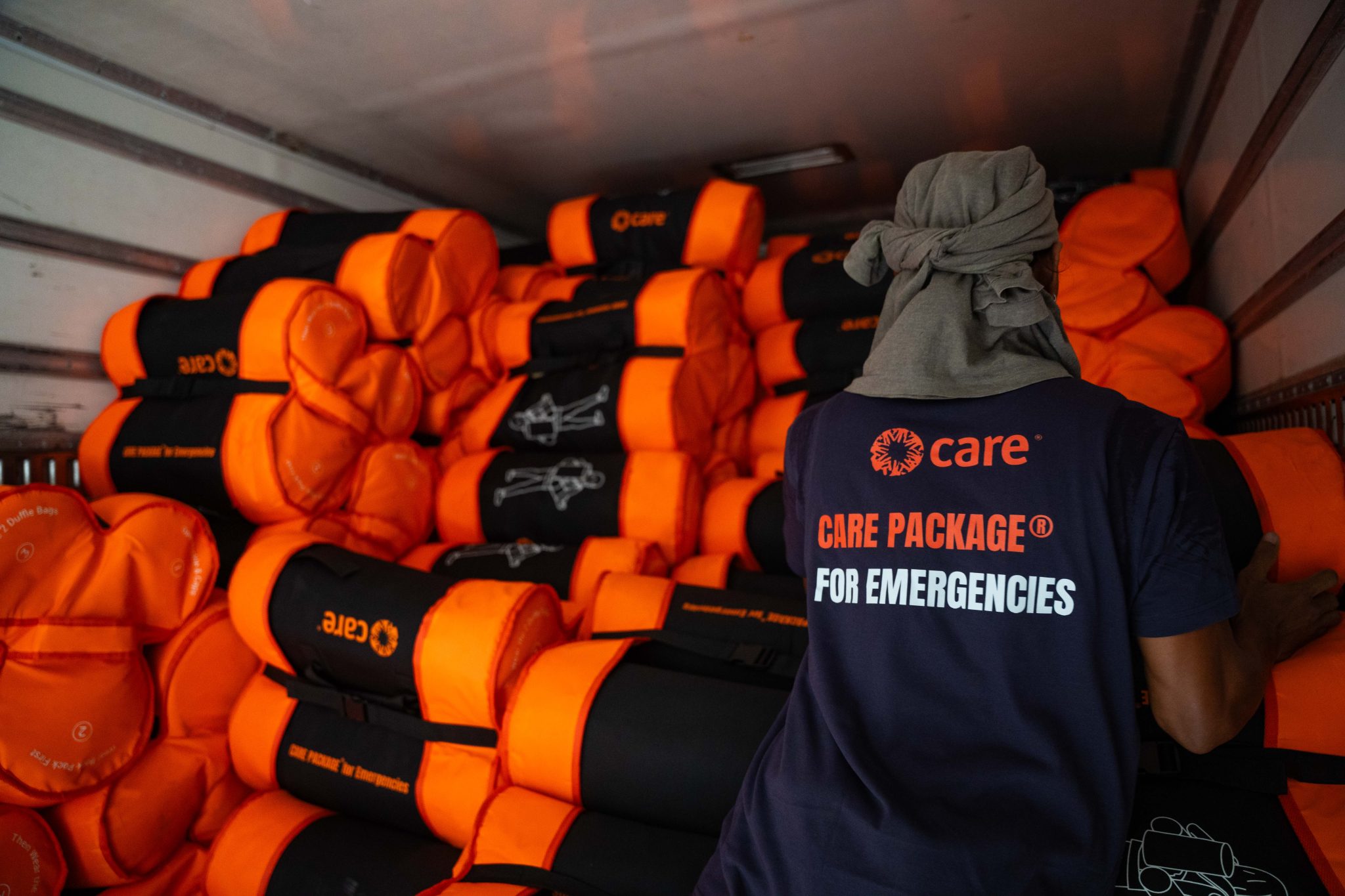
CARE is ready with hundreds of CARE PACKAGE® for Emergencies kits. Each contains five types of support: solar panels for light and charging electronics, tarpaulins and shelter materials, water purification supplies, hygiene items, and kitchen utensils with ready-to-cook and ready-to-eat food. CARE has also sent relief items alongside government distributions to the areas that can be reached.
More than 100 packages have been handed over to the NDRRMA and the Prime Minister’s Office for distribution. The Nepal Army is transporting these supplies to Dhunche, Rasuwa, as additional emergency supplies are mobilised. Families staying in temporary shelters urgently need ready-to-eat food. Longer-term, they will need transitional housing.
CARE Nepal is working directly with authorities to help coordinate the national response. A further 290 community volunteers trained in emergency preparedness are on standby, working alongside the Federal Response Team led by the Prime Minister Relief Committee.
“Our immediate focus is to coordinate closely with the government authorities, humanitarian clusters, and also the local partners so that there is no duplication,” Sherpa says. “The first hours of a disaster are often characterised by incomplete information, and so those who need the right kind of support will not receive it.”
More than 10,000 households along the Trishuli corridor need emergency shelter and relief supplies. Humanitarian organisations are still working out the full scale of what people need.
Sherpa is clear that this is more than an emergency. The flood has cut the only overland route linking Kathmandu to Tibet. On the Tibetan side, the Gyirong Port, which handled nearly a third of trade between Nepal and China in 2024, took the direct force of the floodwaters. Disease is a further risk as floodwaters recede and water and sanitation systems remain damaged.
Drawing on CARE’s work after the 2015 earthquake, Sherpa says, “A longer-term engagement will be required, as the flood will make it harder for people to earn a living, travel, trade, and rebuild local businesses.”
The Government of Nepal has asked both India and China for help with the rescue effort. The Nepali Army, Armed Police Force, and Nepal Police have been deployed for search and rescue.
“We need your solidarity and support at this point,” Sherpa says.
To help support the CARE Floods Emergency Appeal from Australia, donate here.
Your donation could help provide CARE packages, emergency shelter, food and clean water, hygiene supplies and dignity kits for women and girls.
ENDS
For media enquiries contact Julia Dotras on 0494 396 407
About CARE in Nepal
CARE began working in Nepal in 1978 as one of the country’s first international humanitarian organizations. For over 40 years, CARE Nepal has partnered with at-risk communities to fight poverty, promote equality, teach practical skills, and help people build better lives. Today, CARE Nepal works to address the root causes of poverty and discrimination — whether based on gender, background, or location. The organization also helps communities prepare for and respond to environmental change and natural disasters. In fiscal year 2025, CARE in Nepal reached 1.14 million people, 53% of whom were women and girls.
About CARE Australia
CARE Australia supports women around the globe to save lives, defeat poverty and achieve social justice. We work in partnership with local communities to provide equal opportunities for women that they have long been denied: the ability to earn an income, gain access to their fair share of resources, to lead and participate in decisions that affect their lives, and to be able to withstand the increasing impacts of climate disasters and other crises. www.care.org.au